
Hey! 👋
I tested something this week that genuinely changed how I think about AI coding. Not incrementally — fundamentally. Let me explain.
🔥 The Big One
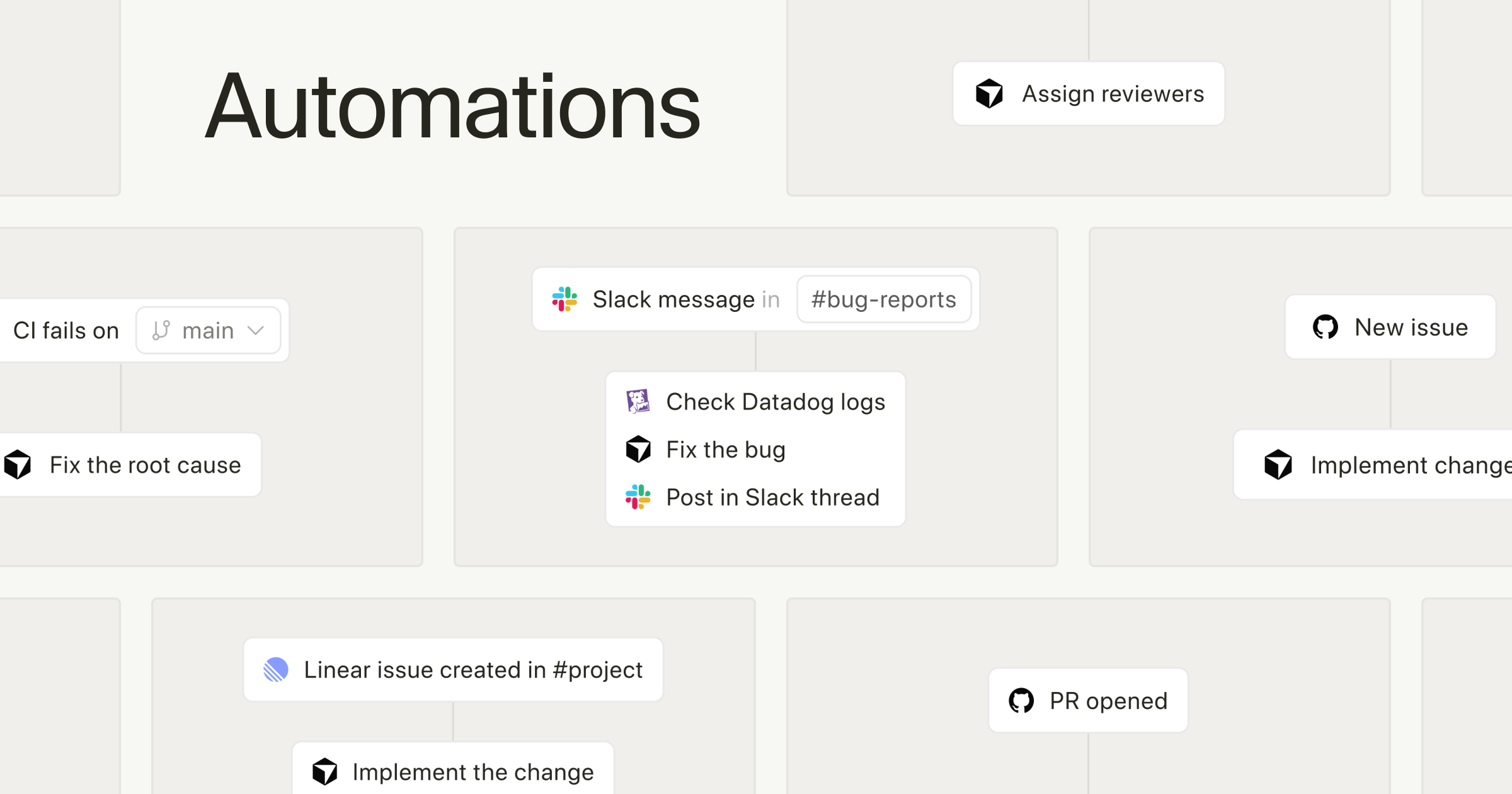
Cursor Automations just changed the game. Your agents now code while you sleep.
Alright, I need to talk about this.
Cursor dropped Automations this week and I've been running them non-stop since Monday. The pitch: always-on agentic coding that triggers without you prompting it. Code commits, Slack messages, PagerDuty incidents, scheduled timers — you set the trigger, Cursor handles the rest.
Here's what that actually looks like in practice. I set up an automation that watches for new GitHub issues labeled `bug`, pulls the relevant code, writes a fix, runs the test suite, and opens a PR. While I'm asleep. I woke up Tuesday morning to three PRs ready for review. Three.
Studies show 84% of devs now use AI tools and AI writes 41% of code, but organizational productivity has barely budged — because engineers can't babysit agents all day.
That stat hit me hard. We've been treating AI coding assistants like really fast interns — useful, but they still need you hovering over their shoulder. Cursor Automations is the shift from "AI helps me code" to "AI codes while I sleep."
Now look — it's not magic. You still need to review the output. You still need good test coverage so you can trust what it ships. But the mental model shift is massive. You're not prompting anymore. You're designing systems that prompt themselves.
This is where I think the real gap opens up. The developers who figure out automation-first workflows in the next 6 months are going to operate at a completely different level than those still tab-completing one file at a time.
My honest take: if you're using Cursor and you haven't set up at least one automation yet, you're leaving the best feature on the table.
"We're introducing Cursor Automations to build always-on agents. Automations run on schedules or are triggered by events — and agents verify their own output." — Cursor Blog
🛠️ What I built this week
Honestly, the Cursor Automations news lit a fire under me. Here's what I shipped:
-
An AI code review bot using Cursor Automations + OpenClaw — Spent most of Monday wiring this up. Every time a team member pushes to our main repo, Cursor spins up an agent that reviews the diff, flags potential issues, and drops a summary in our Slack channel. The first version was way too noisy — but after tweaking the system prompt and adding a severity threshold, it's been genuinely useful. Caught a race condition on Wednesday that I would've missed in manual review.
-
A spec-to-scaffold CLI tool — Inspired by the spec-driven development trend (more on that below). I built a small CLI that takes a markdown spec file, feeds it to Claude, and generates the full project scaffold — folder structure, route files, components, even basic tests. Went from spec to running app in about 12 minutes.
-
A Next.js 16 MCP playground — Next.js 16's built-in MCP server is wild (see below), so I built a small demo app that lets you chat with your running Next.js dev server through Claude. Ask it to run codemods, check build state, test routes — all through natural language. This is the kind of thing that sounds gimmicky until you use it and realise you're never going back.
"The best thing AI did for me this week wasn't writing code — it was designing systems that write code for me. That's the real shift." — Sonny
⚡ What shipped this week
1. Vite 8.0 — Rust ate your bundler (and it's faster)

Vite 8.0 shipped with Rolldown, the new Rust-powered bundler that replaces both esbuild AND Rollup in a single pass. We're talking 10-30x faster builds. I migrated one of our larger projects on Thursday — build time went from 34 seconds to just under 3. At 65M downloads/week, Vite is the default now. If you're still on Webpack... I don't know what to tell you.
"Rolldown replaces esbuild + Rollup with a single Rust-based bundler, delivering 10-30x build performance improvements." — Vite Blog
2. Next.js 16 MCP Server — Your AI agent can talk to your app now
This is sneaky-important. Next.js 16 ships with a built-in DevTools MCP server that lets AI agents interact with your app's build state, run codemods, and test pages. I've been using this with Claude all week and it feels like cheating. You can literally ask your AI to "check if the /dashboard route renders correctly" and it'll hit your dev server, test it, and report back. The line between IDE and AI just disappeared.
"Next.js 16 includes a built-in MCP server enabling AI agents to interact with build state, run codemods, and test pages." — Next.js Docs
3. TypeScript 6.0 RC — The last TypeScript written in TypeScript

Let that sink in. TypeScript 6.0 RC is out, and it's the final version written in TypeScript itself. The Go rewrite (TS 7.0) is coming with 10x performance improvements. This release includes the Temporal API (finally, proper date handling) and a bunch of DX improvements. It's a bridge release — solid, stable, and the end of an era.
"TypeScript 6.0 RC arrives as the last version written in TypeScript, with the Go-based 7.0 promising 10x performance gains." — The New Stack
4. Claude gets 1M token memory — free for everyone
Anthropic gave every Claude user 1 million tokens of persistent memory across sessions. Free. No Pro plan required. Plus 600 images/PDF pages per request. I've been using this to dump entire codebases into Claude and have it remember context between sessions. No more re-explaining your project every time you start a new chat. This is a massive quality-of-life upgrade.
"Anthropic hands every Claude user a million-token memory and persistent context across sessions, free of charge." — WebProNews
5. Microsoft quietly retreats from AI bloat

In the most unexpected move of the week, Microsoft is pulling Copilot out of Windows 11 notifications and settings. They're making AI features optional instead of force-feeding them. I honestly respect this. The "shove AI into everything" approach was backfiring, and they're course-correcting. More companies should take notes.
"Microsoft quietly scraps plans to bring Copilot to notifications and settings on Windows 11, moving to reduce AI bloat across the OS." — Windows Central
🧰 Worth your time
-
Spec-Driven Development: The counter to vibe coding — Write specs first, let agents implement, validate with tests. This is the methodology I've been gravitating toward — and it's why I built that spec-to-scaffold tool this week. Vibe coding is fun for prototypes. Spec-driven is how you ship production code with AI.
-
GitHub cuts premium AI models from student plan — GitHub removed GPT-5.4 and Claude Opus from the free student tier. Not a great look. Students are your future power users — limiting their access to the best models feels short-sighted.
-
Cursor 2.0: 8 parallel agents and JetBrains support — Beyond Automations, Cursor 2.0 also shipped 8 parallel agents, JetBrains support via ACP, and Plan Mode. If you're a JetBrains user who's been on the fence — the fence is gone.
My weekly message to YOU!
The biggest shift in AI coding isn't better autocomplete. It's removing yourself from the loop entirely — for the right tasks. Set the trigger. Define the guardrails. Let the agent run. Review the output.
You're not a developer who uses AI anymore. You're a systems designer who happens to write code sometimes.
That's the unlock.
So here's your challenge this week: set up one automation that runs without you. A code review bot. A test runner. A PR labeler. Anything. Just get one agent working while you're not watching.
Have you tried any always-on AI coding workflows yet? What triggers would you set up first? Hit reply — I want to hear it.
I read every single one.
Talk soon PAPAFAM,
Sonny 👋🏼
👇🏽 Don't forget to follow me across socials!


Responses