
That boost has ended. From 14 September, the weekly allowance is about 17% lower than the promotional level users had last week.
If you rely on Claude Code for long coding sessions, it is worth checking whether your usual workload still fits. Here is what changed—and how to check your weekly allowance.
This week: what changed in Claude Code, Google’s new voice models, and the tools making agents easier to build, run and check.
🔥 The Big One

You now get less Claude Code usage each week
Claude Code’s temporary weekly usage boost has ended. The replacement allowance, effective 14 September, gives users on Pro, Max, Team and seat-based Enterprise plans about 17% less weekly capacity than the promotional level.
This is not a fresh surprise announcement: Anthropic announced the change in August. It is the change taking effect this week that matters for your workload.
Why might you have seen it described as an increase? Anthropic’s official announcement said:
“Starting September 14, we're permanently raising standard weekly limits in Claude Code by 25% for Pro, Max, Team, and seat-based Enterprise plans.” (ClaudeDevs)
Read Anthropic’s announcement → · Read the comparison →
⚡ What shipped this week
1. Gemini 3.8 Live keeps the conversation moving

Google introduced Gemini 3.8 Live and Live Extended Thinking on 15 September. The practical change is background work without making the whole conversation stop.
“It executes tools and API calls in the background while continuing the conversation, so the model can acknowledge requests and keep chatting while tasks finish in the background.” (Google)
Imagine explaining a UI change while the agent is still working on the previous instruction. That is a much better interaction than taking turns with a loading spinner. The developer rollout starts in the Gemini API and Google AI Studio; enterprise availability includes private preview, not blanket general availability.
OpenAI also released GPT-Live-1 this week, separating its voice layer from the reasoning backend. One detail in its docs deserves a test case: interrupting speech does not automatically cancel backend work. Build cancellation deliberately. A quiet agent might still be doing something.
2. OpenAI puts the engine behind Codex in an API

OpenAI introduced the Agents API on 10 September in public beta for all developers. It provides the harness—the software that manages sessions, tools and context—behind Codex as a managed service.
Your app supplies the tools and chooses the execution environment. Durable sessions let you follow progress and continue the same job, rather than rebuilding the agent loop yourself.
The trade-off: current docs specify US-only data residency and no Zero Data Retention, even with a self-hosted sandbox. There is no additional Agents API fee, but model, tool and hosted-container usage still costs money.
Try it on one bounded task before moving a sensitive workflow. You are renting infrastructure, not outsourcing responsibility for the result.
Read the announcement → · Check the API docs →
3. Mastra Factory makes the delivery process configurable
Mastra Factory connects an existing repository and issues to a configurable development lifecycle: triage, planning, implementation and pull request review. It surfaced in this week's Product Hunt notes; its live product page verifies the workflow, not a dated general-availability announcement.
“Mastra Factory keeps humans in the loop at key stages.” (Mastra)
The interesting part is not another coding chat. It is having one place to answer the agent's questions, adjust the plan and continue the conversation attached to that issue.
Factory is open source, but the default setup uses Mastra platform services. Do not read that as a completely local, zero-cost system. I would trial it on a small queue of well-defined bugs and watch where work actually stalls: unclear requirements, implementation or review.
4. SWE-2 targets the agent that reads forever before editing
Cognition released SWE-2 on 10 September, with availability in Devin Desktop and CLI and a rollout to Web and Fusion. Its research focuses on making coding agents more capable without wasting as much effort exploring irrelevant code.
On its FrontierCode 1.1 Main evaluation, Cognition reports:
“SWE-2 medium making its first real edit after a median of 18 steps, compared with 48 for SWE-1.7.” (Cognition)
That is vendor benchmark evidence, not a promise about your repository. Still, it identifies a useful failure mode: an agent can look busy while postponing the actual change.
Do not reward the fastest first edit blindly. Check whether it found the right files, made a complete fix and ran meaningful tests. Less wandering only counts when the result holds up.
5. OpenObserve connects agent quality to the trace behind it
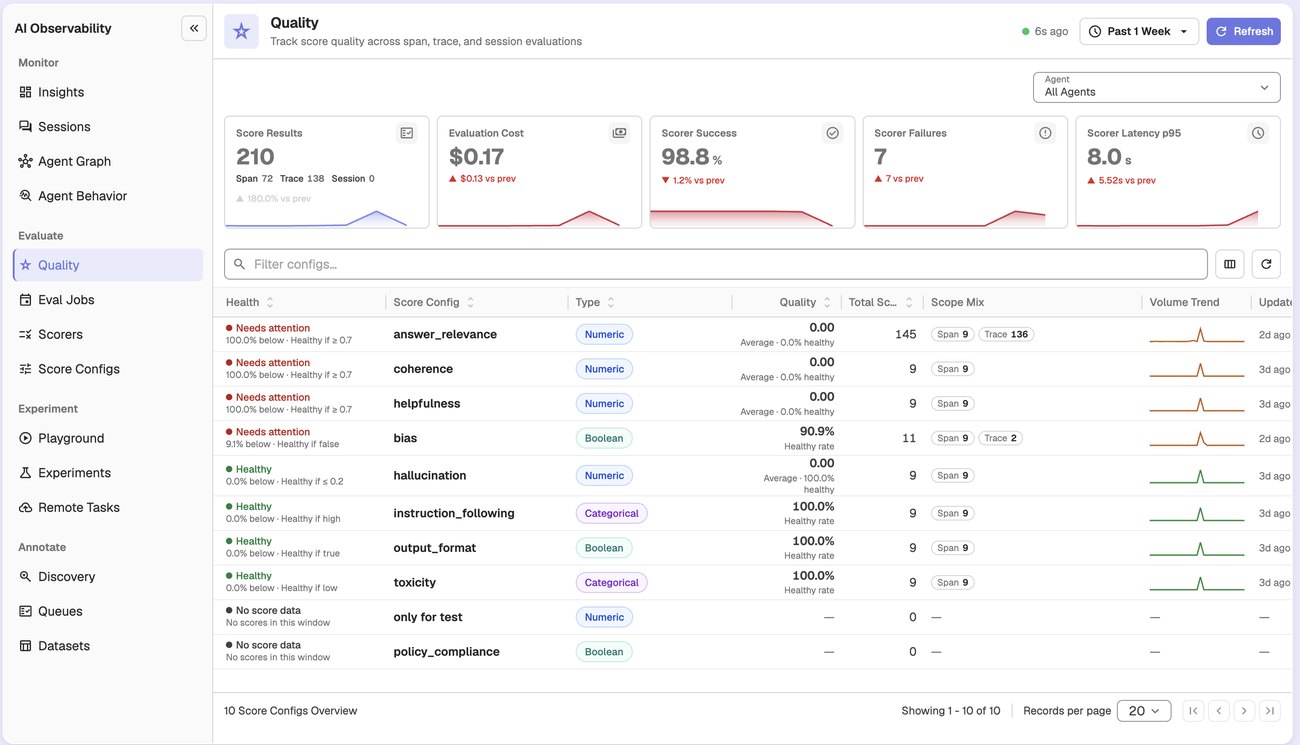
A successful request does not mean a successful answer. OpenObserve's AI Observability pairs traces with quality scoring, human review and datasets you can use to compare the next version.
One design detail stood out:
“Tightening a rubric never rewrites last quarter's numbers.” (OpenObserve)
Versioned scoring matters. Otherwise, changing your definition of “good” can make an old system appear better or worse without the system changing at all.
This was another discovery from the week's launch notes. The official page confirms the capabilities and says evaluation features are enterprise-only. The practical lesson works with any stack: keep the failing input, expected outcome and scoring rules together, then rerun them before shipping a fix.
🧰 Worth your time
-
QApilot MCP for Android: Turn an agent-driven Android check into saved, replayable tests. Its guide still requires Appium setup, and explicitly saved tests go to QApilot. “No Appium code” is not “no Appium.”
-
Copilot cost and quality controls: Efficiency, balance and intelligence steer automatic selection from the same available model pool. Pick the trade-off, then measure the actual job rather than assuming a tier guarantees one model.
-
v0 one-click integrations: Connect supported email, auth, search and database providers inside chat. Useful for moving past a convincing mock-up into a working app; check the connected provider's account and billing requirements.
This week's challenge: pick one real coding task and track the usage, time and verification it takes. Compare completed work, not just subscription headlines or model names.
Have you hit Claude Code’s weekly limit, or do you still have plenty of headroom? Hit reply and tell me what your workload looks like.
I read every single one.
Talk soon PAPAFAM,
Sonny 👋🏼
👇🏽 Don't forget to follow me across socials!



Responses