
Hey PAPAFAM 👋🏼
Your coding agent needs an answer. You have stepped away from your desk. Until you reply, that task is going nowhere.
Cursor’s latest update gives you a practical way back into that conversation: its iPhone app can now show and message agents running on your computer. No move to a cloud agent required. That is this week’s lead: less time tied to your desk, without pretending your laptop can switch off.
We are also looking at Google’s next frontier model, richer local search, and a better way to review large code changes. More capable agents are useful. Keeping their work moving—and checking what they actually changed—is the part that matters.
🔥 The Big One
You can now control your Cursor agents from your iPhone
Cursor's 6 October update lets you see and reply to local coding agents from the Cursor iOS app. If an agent needs clarification while you are away from your desk, you can send an answer from your phone rather than waiting until you get back.
Getting started is straightforward: download the iOS app, sign in, select your computer and approve the pairing request in Cursor on that computer. Your local agents then appear in a list, where you can check what each one is doing or send it a message.
“Remote control doesn't require cloud agents to work.” (Cursor)
⚡ What shipped this week
1. Gemini 4 Argon takes on large codebase migrations

Google announced Gemini 4 Argon on 30 September. Its strongest builder story is not a leaderboard position. Google says Argon agents are working on C/C++ to Rust migrations ranging from core libraries to more than 800,000 lines for the Fuchsia Zircon kernel.
That does not mean an agent rewrote a kernel and shipped it unchecked. Google explicitly says these rewrites are undergoing automated and manual auditing, emulation testing and review before production rollout. These are vendor-reported engineering examples, not independently reproduced results.
The other notable change is an output limit of one million tokens, up from the previous 64,000. That is output headroom for long reasoning and generation, not a claim about the amount of source code you can paste into the input.
“Google engineers have been using Argon for their daily tasks, from everyday debugging to large-scale codebase migrations and algorithm designs.” (Google)
2. EmbeddingGemma 2 brings images and audio into local search
Google released EmbeddingGemma 2 on 6 October under Apache 2.0. It maps text, code, images, video and audio into a shared embedding space: numerical representations you can search by meaning rather than exact words.
“Requires as little as 270M parameters for text-only workloads with optional vision (170M) and audio (300M) encoders for full multimodal support.” (Google)
Explore the model and developer links →
3. GitHub makes stacked pull requests generally available
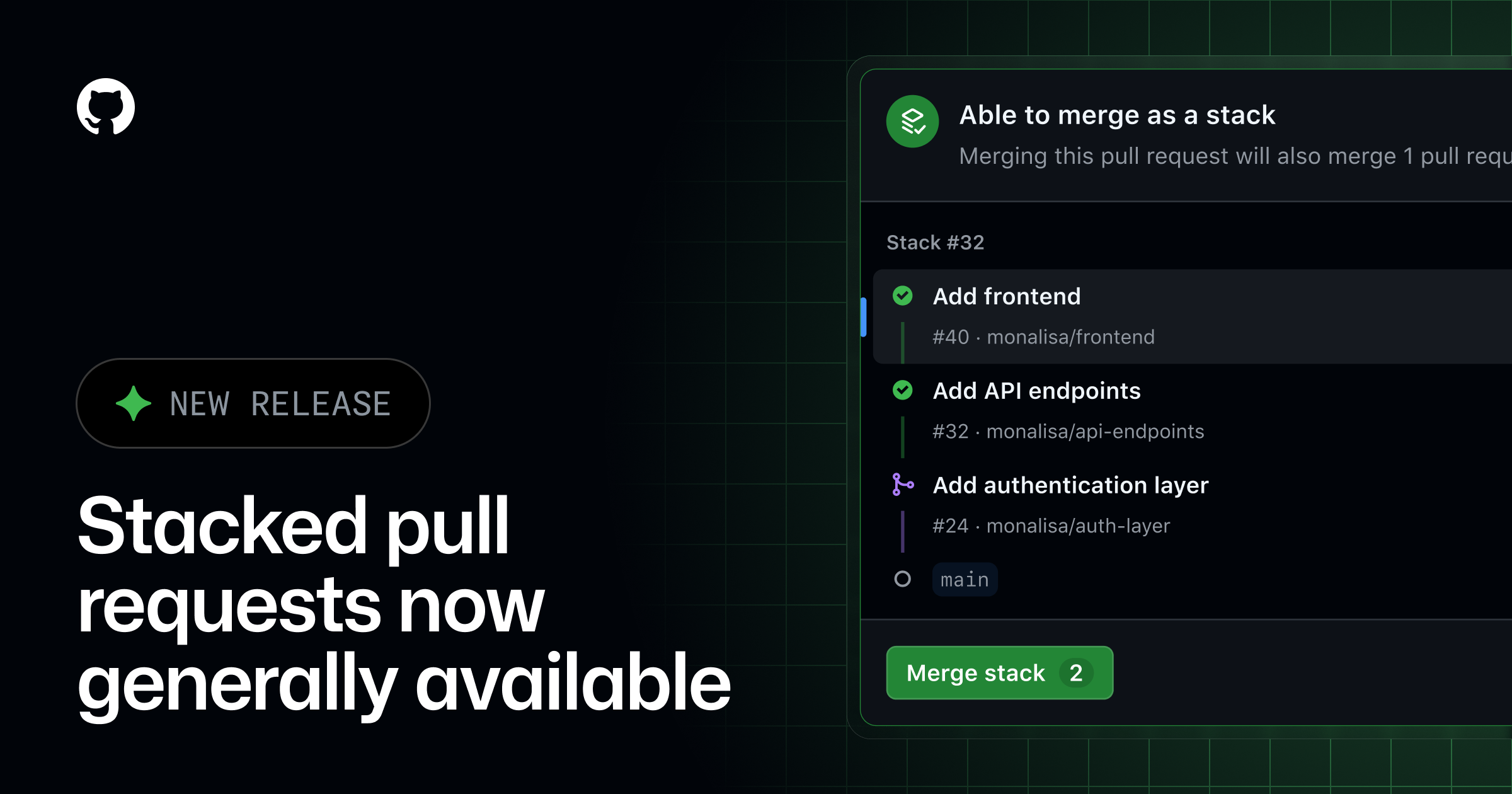
A stack breaks a large change into dependent, focused pull requests that can be reviewed separately and merged together. GitHub's 6 October announcement makes the feature generally available.
“Stacked pull requests are available on all github.com plans and will be included in an upcoming GitHub Enterprise Server release.” (GitHub)
The release preserves approvals when unchanged code is rebased, and the CLI extension now supports worktrees. Stack auto-merge is rolling out over the next few weeks, so do not assume every feature is already enabled everywhere.
This is a useful companion to ambitious coding agents: ask for a reviewable sequence, not one enormous diff. A reviewer should be able to explain each change without reconstructing the entire project.
4. Rill connects the page you are reading to your coding project
A discovery from this week's launch notes: Rill is a free beta browser for Apple silicon Macs running macOS 14 or later. Its AI features use your existing Claude Code or Codex plan, so free browser access does not mean free model usage.
You can send a task from a page into a project it finds in your coding-agent history. A migration guide becomes something to investigate in the relevant repository, rather than another forgotten tab.
“New tasks are read-only until you allow edits, and in git repositories each edit can be undone.” (Rill)
That is the vendor's stated behaviour, not a hands-on security audit. Rill acknowledges prompt-injection risk remains. Try a disposable project first and inspect the proposed edits. Its Product Hunt discovery date is not a verified general-availability date.
🧰 Worth your time
-
AUDR: An open agent-usage record format connecting a run's resource consumption to the customer or feature responsible. It records usage and attribution; prices and billing logic belong elsewhere. Useful if separate dashboards cannot explain one finished job.
-
Vercel decision fallbacks: A beta for escalating uncertain decisions to another model using configured confidence conditions. Both stages are billed when a fallback runs. Measure better decisions against the extra cost, not confidence alone.
-
Claude Frontier Academy: Anthropic is committing $100 million with a goal of training 10,000 engineers by the end of 2027. Participation is by organizational nomination, not open enrollment. The useful career signal: real deployment work, not just prompt fluency.
This week’s challenge: try one small agent task with a clear finish line. If you use Cursor on iPhone, check in away from your desk, then return to review the result. The goal is less waiting—not less verification.
Would checking your coding agents from your phone genuinely free you from your desk—or just make it harder to switch off? Hit reply and tell me.
I read every single one.
Talk soon PAPAFAM,
Sonny 👋🏼
👇🏽 Don't forget to follow me across socials!



Responses