
This week really clicked for me in a different way.
I’m not looking at AI coding tools as “which chatbot got smarter?” anymore. I’m looking at them as the new operating layer for how builders actually ship.
🔥 The Big One
AI coding just crossed from assistant feature into full-stack operating model.
The biggest signal this week wasn’t one isolated model drop. It was the pattern. Meta is now talking about parallel subagents, GitHub is pushing deeper into cloud execution, OpenAI is shifting Codex toward infrastructure-style pricing, and GitHub is forcing builders to think harder about where their interaction data actually goes.
That’s why Meta’s Muse Spark launch matters more than it first appears. Meta says Muse Spark is the first model in its new Muse series from Meta Superintelligence Labs, and that it now powers Meta AI across the Meta AI app and meta.ai. More importantly, Meta says the model is built for complex reasoning and multimodal tasks, and that Meta AI can now launch multiple subagents in parallel for a single task.
The part that jumped out at me most? Meta explicitly says Muse Spark “excels at visual coding”, including building custom websites and mini-games from a prompt. That’s not a random demo bullet. That’s Meta signaling exactly where this market is going: fewer one-shot answers, more delegated systems that can reason, generate, iterate, and ship.
My take: the AI dev stack war is now being fought on three fronts at once — agent workflows, pricing economics, and data governance. If you’re building with AI, that means your edge won’t come from “using AI” anymore. It’ll come from choosing the right workflow, the right cost model, and the right trust boundary.
“Meta AI can now launch multiple subagents in parallel for a single task.” — Meta
🛠️ What I built this week
This week’s news made one thing obvious: if the tools are becoming operating systems, builders need systems too.
-
Agent-first content workflow — I’ve been thinking more about workflows where AI doesn’t just help write, but actually handles research, structuring, and first-pass production in parallel.
-
OpenClaw + n8n workflow building — I used OpenClaw to think through n8n automation architecture before building, which made a massive difference. Instead of stitching together brittle node chains manually, I could prompt through the logic, edge cases, branching, retries, and failure states up front. The result was way more reliable workflows with cleaner node design, better fallbacks, and automations that actually feel production-ready instead of hacked together.
-
Usage-aware build stack — The move toward token-style economics makes me want every serious builder tracking which AI tasks create leverage, and which ones just create burn.
“The winners won’t be the people with the most tools. They’ll be the builders with the cleanest workflows.” — Sonny
⚡ What shipped this week
1. GPT-5.4-Cyber shows where frontier models are heading next
This is the kind of launch that matters even if you never touch the model directly. OpenAI unveiled GPT-5.4-Cyber, a variant of GPT-5.4 tuned specifically for defensive cybersecurity work. That tells me the frontier labs are moving beyond one-size-fits-all releases and toward specialized models for specific, high-value workflows.
That’s a big deal for builders. It suggests the future of AI tooling is not just “pick the smartest general model.” It’s going to be picking the right model for the exact job: coding, security review, support, research, or ops. In other words, the stack is getting more modular.
“OpenAI on Tuesday unveiled GPT-5.4-Cyber, a variant of its latest flagship model fine-tuned specifically for defensive cybersecurity work.” — Reuters
2. GitHub updates Copilot data policy — builders need to pay attention to what “using AI” really means
This is one of the most important builder stories of the week. GitHub says that from April 24 onward, interaction data from Copilot Free, Pro, and Pro+ may be used to train and improve AI models unless users opt out. GitHub also says Copilot Business and Enterprise users are not affected, and that it is not training on the contents of private repos “at rest.” But during active use, the covered data can include prompts, outputs, snippets, surrounding context, comments, file names, repository structure, and navigation patterns. Translation: if you’re using a personal tier on sensitive code, you need to actually understand the policy instead of assuming “private repo” equals “nothing is used.”
“From April 24 onward, interaction data from Copilot Free, Pro, and Pro+ users may be used to train and improve AI models unless users opt out.” — GitHub
3. GitHub expands Copilot cloud agent — autocomplete is turning into delegated execution
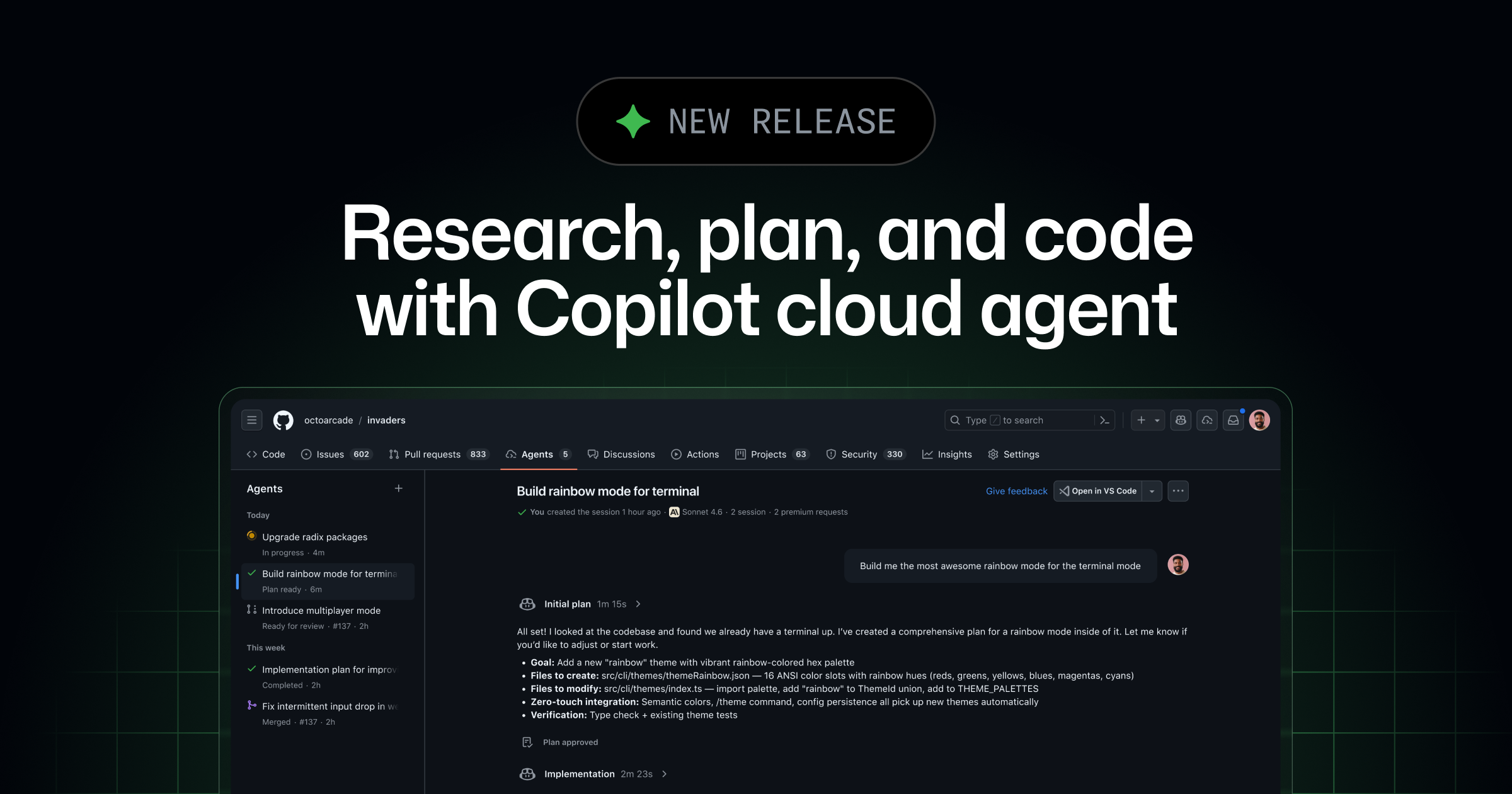
This is exactly where the market is heading. GitHub says Copilot cloud agent is no longer limited to pull request workflows and can now work on a branch without opening a PR first. It also added implementation-plan generation so teams can review the plan before code gets written, plus repo-grounded deep research and a “Fix with Copilot” flow that can resolve merge conflicts, run builds/tests, and push changes from its own cloud environment. That’s not “better chat.” That’s branch-level delegated work. And yes, that matters a lot more than yet another benchmark chart.
“Copilot cloud agent is no longer limited to pull-request workflows and can now work on a branch without opening a PR first.” — GitHub Changelog
4. JetBrains’ survey shows AI coding is mainstream — but the leaderboard is fragmenting fast
The adoption curve is basically settled. The interesting part now is the fragmentation. JetBrains says 90% of developers in its January 2026 AI Pulse survey regularly used at least one AI tool at work for coding and development tasks, and 74% had adopted specialized AI tools for developers. GitHub Copilot was still the most adopted at-work tool at 29%, but Claude Code and Cursor were tied for second at 18% each. That tells me we’re not heading toward one winner. We’re heading toward a multi-tool stack where incumbency, workflow quality, and specialization all matter.
“90% of developers in our survey regularly used at least one AI tool at work for coding and development tasks.” — JetBrains
🧰 Worth your time
-
OpenAI unveils GPT-5.4-Cyber for defensive security work — Security is becoming its own premium lane inside AI tooling. That’s a strong hint that the future won’t be one general-purpose model for everything, but more domain-tuned models for serious workflows.
-
Anthropic’s coding-agent momentum is strong enough to reshape the map — Even when Anthropic isn’t the main headline, Claude Code keeps showing up as the pressure forcing everyone else to react. If you want to understand why the market is moving so aggressively right now, read this.
-
Meta’s Muse Spark announcement — I used Meta’s newsroom piece for the main story, but the Meta AI blog is also worth reading because it helps frame how Meta wants developers to think about multimodal, agentic, visual-first workflows.
My weekly message to YOU!
Here’s my challenge for you this week: stop thinking about AI as a feature, and start treating it like infrastructure.
That means asking three simple questions before you adopt any new tool: What work can it actually own? How does the cost scale? And where does my data go?
If you get those three right, you’ll make better decisions than 95% of builders who are still chasing hype clips on X.
Reply and tell me this: what’s one AI workflow you’re using right now that actually saves you real time?
I read every single one.
Talk soon PAPAFAM,
Sonny 👋🏼
👇🏽 Don't forget to follow me across socials!




Responses