
Anthropic's new Claude Fable 5.1 is built around that longer loop. The capability matters, but the more useful story for builders is what Anthropic changed underneath it: repeated context got much cheaper.
That turns prompt caching from a billing trick into an architecture decision.
🔥 The Big One
Claude Fable 5.1 makes long-running agents cheaper to operate

Anthropic launched Claude Fable 5.1 on 1 September for coding, knowledge work and long-running problem solving.
Anthropic estimates Fable 5.1 costs about 25% less than Fable 5 for typical token-billed workloads, with savings of up to roughly 45% for highly agentic work. Those are Anthropic's estimates, not an independent benchmark, but the direction is important.
A coding agent repeatedly reads the same architecture notes, dependency graph, tool instructions and recent changes. If that stable context stays cached, the expensive part becomes the new work rather than paying full input price every time the agent looks back.
“Fable 5.1 sets a new standard for coding, knowledge work, and long-running problem-solving tasks.” (Anthropic)
Anthropic also introduced Claude Mythos 5.1, the same underlying model with restricted trusted access for advanced cyber and life-science work. For most developers, Fable 5.1 is the product that is actually available now.
Read Anthropic's announcement →
⚡ What shipped this week
1. GitHub Copilot can approve pull requests when admins opt in
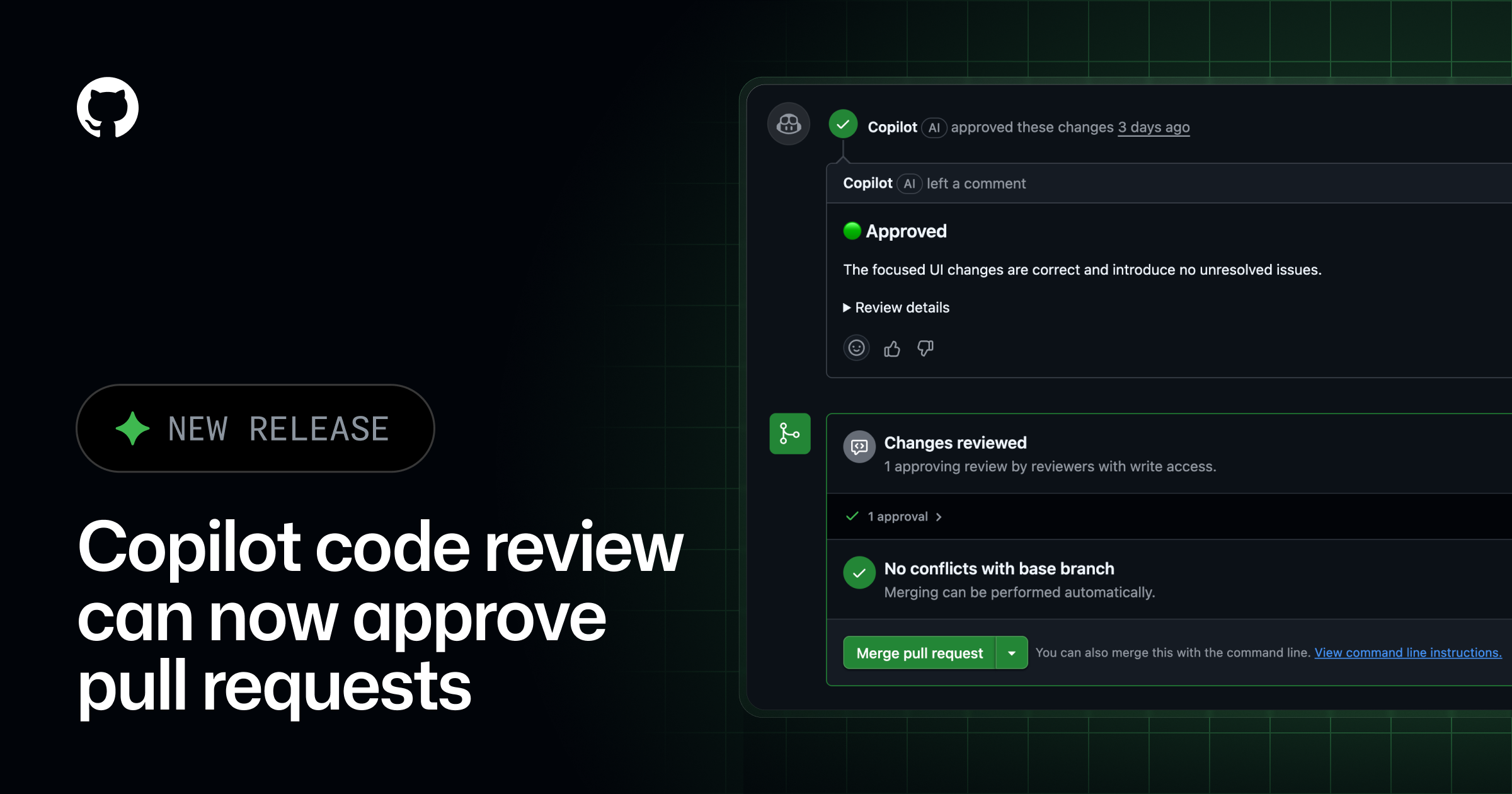
GitHub moved Copilot code review from advice into merge control. Every review now includes an approval assessment, and admins can let Copilot submit an approval that counts toward required approvals.
“The ability for Copilot to approve is off by default and configurable at the enterprise, organization, and repository level.” (GitHub)
That boundary matters. The feature is in public preview, can be limited by file path, and a new commit dismisses the approval. If you enable it, start with low-risk repositories and keep human review mandatory for auth, payments, infrastructure and data migrations.
2. AWS gave coding agents a first-party setup command
AWS added Agent Toolkit setup to AWS CLI 2.35.0. Running aws configure agent-toolkit detects supported coding agents, installs AWS-maintained skills and configures the AWS MCP Server using your existing IAM credentials.
“With one command in the AWS Command Line Interface (AWS CLI), your coding agent gets curated AWS expertise.” (AWS)
This is what useful vendor tooling looks like: current service knowledge plus an authenticated route to real APIs. The MCP connection still inherits IAM, so the right move is a dedicated least-privilege role, not handing your coding agent the same credentials you use as an administrator.
3. Kilo brought parallel coding agents to JetBrains
Kilo launched a native JetBrains plugin for IntelliJ, PyCharm, WebStorm, GoLand, Rider and other JetBrains IDEs. It can run agents in isolated Git worktrees, show their diffs and pull requests, and support split local or remote development.
“Kilo turns your JetBrains IDE into a multi-agent control room.” (Kilo)
This is bigger than another editor extension. JetBrains teams can test parallel agent workflows without migrating their whole development environment. Keep each agent on one bounded task, compare the diffs, and merge the best result rather than letting five agents edit the same branch.
4. Firecrawl built a search index for coding agents

Firecrawl's Developer Index searches more than 70 million technical documents, READMEs, issues and merged pull requests. It is available through an API, CLI, skill and MCP server, with most sources refreshed daily.
“70M+ docs, READMEs, issues, and merged pull requests in one index, with the highest recall of any coding-specific index.” (Firecrawl)
“Highest recall” comes from Firecrawl's own evaluation, so treat that as a vendor claim. The useful idea is source selection: when an agent is debugging an obscure library edge case, the answer may live in a merged pull request or issue, not the polished docs. Make the retrieved source visible before trusting the fix.
🧰 Worth your time
-
Hugging Face WebGPU kernels: 207 versioned kernels with interfaces, correctness tests and benchmarks for local browser AI. This is the boring infrastructure that makes on-device demos easier to turn into products.
-
Computable GPU Index: A reproducible reference index for published on-demand H100, H200, B200 and B300 rates, refreshed every 15 minutes and exposed through read-only MCP. Useful for estimates, but it does not prove inventory or your final workload cost.
-
ChatCut Desktop: Prompt-driven video editing on macOS, Windows and the browser, with a visible timeline and Claude Code or ChatGPT integrations. The current paid plans start at $25 per month, so check the credit model before moving a long edit into it.
Here is the practical challenge this week.
Take one coding-agent workflow and split its input into stable context and changing context. Cache the architecture, conventions and tool instructions. Send only the new diff, error and task state on each turn. Then measure cost per completed job, not cost per prompt.
What is costing your agents more right now: model intelligence, repeated context, or failed attempts?
Hit reply and tell me.
I read every single one.
Talk soon PAPAFAM,
Sonny 👋🏼
👇🏽 Don't forget to follow me across socials!




Responses